


It is important to Angel Refrigeration that we help you choose the right product to do the right job!
Please contact our Sales Team for further information, help and advice.

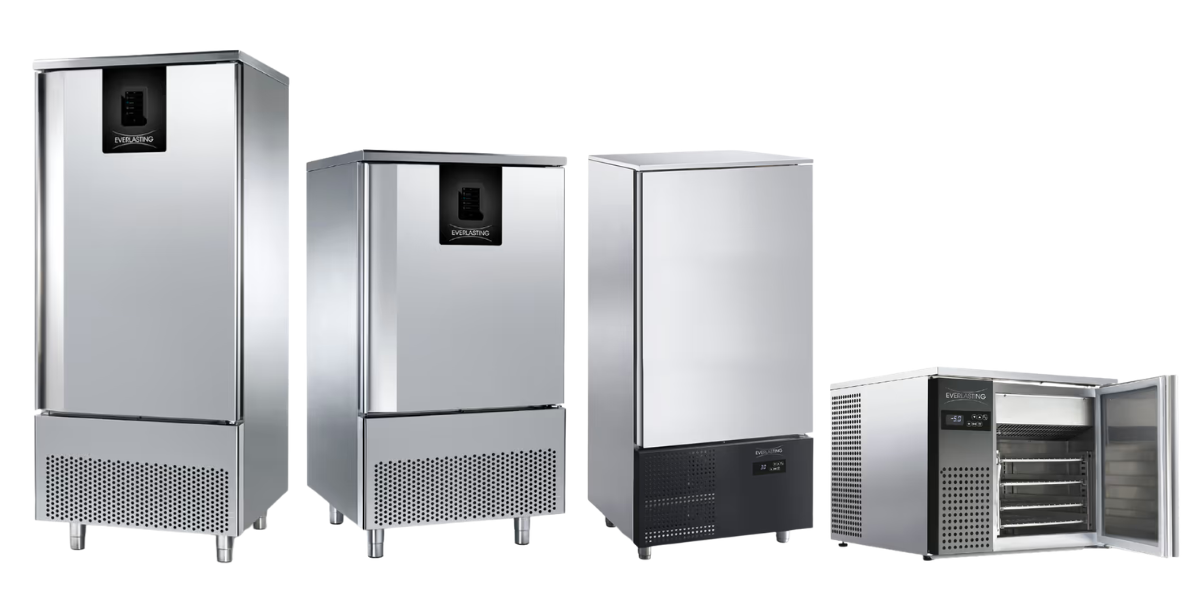
Commercial blast chillers are designed to do more than reduce food temperatures quickly. Modern equipment offers a range of cooling programmes, temperature controls and specialist functions that can help food businesses improve product quality, manage production and maintain consistent processes.
Italian refrigeration manufacturer Everlasting offers a comprehensive range of blast chillers and shock freezers, from compact countertop models to high-capacity professional cabinets.
Understanding the differences between the Basic, Professional and Professional Multifunction ranges can help businesses select equipment that meets their production requirements without investing in unnecessary features or compromising on essential capabilities.
All three ranges are designed around the principles of rapid chilling and freezing, using powerful refrigeration and controlled airflow to reduce food temperatures.
The principal differences concern the sophistication of the controls, the ability to customise cooling programmes and the availability of additional food processing functions.
The Everlasting Basic range provides straightforward blast cilling and shock freezing for commercial kitchens requiring reliable temperature reduction without complex programming.
Designed with practicality and ease of use in mind. Basic models are suitable for businesses where rapid cooling and freezing are the primary requirements.
Key capabilities across the range include:
The Basic range is particularly suitable for restaurants, smaller commercial kitchens, cafés and food producers seeking dedicated chilling and freezing equipment.
It provides the essential functions required for controlled cooling without the additional programming capabilities of the Professional range.
The Everlasting Professional range builds upon the core chilling and freezing capabilities of the Basic models, introducing more sophisticated controls and greater flexibility.
Professional cabinets are designed for businesses that require greater control over cooling processes, particularly where different products, batch sizes or production methods are involved.
Depending on the model and configuration, features include:
The ability to customise cooling programmes is particularly useful for businesses handling products with different cooling requirements.
A bakery processing delicate desserts, for example, may require different cooling conditions from a commercial kitchen chilling dense, cooked meat products.
Professional blast chillers allow operators to develop more consistent, repeatable processes suited to their products.
The Everlasting Professional Multifunction range extends the capabilities of the Professional series by incorporating additional food processing functions.
Rather than serving exclusively as a blast chiller and shock freezer, these models can support a wider range of temperature-controlled production processes.
Depending on the model and specification, multifunction capabilities include:
These additional functions can make multifunction equipment particularly attractive to bakeries, patisseries, professional kitchens and food producers seeking greater versatility from their available equipment.
For businesses with limited production space, combining several processes within one cabinet may reduce the need for separate specialist appliances.
However, the value of multifunction equipment depends on how frequently each process will be used and whether the production schedule allows the cabinet to be shared between different operations.
Beyond the differences between product ranges, several important technologies influence how a blast chiller operates and howeffectively it can be integrated into a commercial food production environment.
Different foods require different cooling conditions.
Everlasting blast chillers offer soft and hard chilling programmes to accommodate variations in product size, composition and sensitivity.
Soft chilling is designed for products that benefit from gentler cooling conditions.
This can include delicate desserts, vegetables, thin products and other foods where aggressive cooling could adversely affect surface quality.
Hard chilling uses more intensive cooling conditions and is generally better suited to dense, larger or packaged products that retain heat for longer.
The distinction is important because the most aggressive cooling programme is not necessarily the most suitable for every product.
Choosing the correct cycle helps balance cooling performance with the preservation of product quality.
The same principles apply to blast freezing.
Soft freezing uses a more gradual initial cooling process before moving into intensive freezing conditions. It is intended to help protect delicate products while still achieving the required frozen core temperature.
Hard freezing is designed to reduce product temperatures more aggressively, making it suitable for larger, denser or appropriately packaged foods.
Rapid freezing can help limit the formation of large ice crystals, reducing the potential for structural damage and moisture loss during subsequent thawing.
The appropriate programme depends on the product's composition, size and intended use.
The temperature at the centre of a food product can differ significantly from the temperature at its surface.
Core temperature probes allow a blast chiller to monitor the temperature within the product during a cooling or freezing cycle.
Instead of relying solely on a predetermined operating time,the equipment can respond to the measured core temperature.
When the required temperature is reached, the programme can finish and automatically transition to the appropriate holding mode.
This is particularly valuable when processing products of varying thickness, density or weight.
Core temperature monitoring also helps operators establish repeatable cooling procedures and supports food safety documentation.
Timed cycles allow operators to select a cooling or freezing programme with a defined duration.
These programmes can be useful where product characteristics and batch quantities are consistent and the cooling process has already been established and validated.
Timed operation provides a straightforward alternative to probe-controlled cycles, although the product's actual core temperature must still be verified as appropriate.
Both methods have their place in commercial production, and the most suitable approach depends on the food being processed and the operational requirements.
Professional models offer greater flexibility through programmable cooling cycles.
Rather than relying entirely on fixed programmes, operators can configure cooling parameters to suit particular products or production methods.
This can be particularly useful for businesses repeatedly processing products with specific temperature requirements.
Multi-stage programmes allow the cooling conditions to change during a cycle, helping operators manage the transition between different phases of temperature reduction.
Once suitable programmes have been established, they can support more consistent results and simplify routine production.
Air circulation is essential to effective blast chilling.
Powerful fans move cold air around the products, increasing the rate of heat transfer and helping distribute cooling throughout thecabinet.
However, airflow requirements can vary between products.
Delicate foods may benefit from gentler air circulation,while larger or denser products may require more intensive cooling.
Where supported, adjustable ventilation allows operators to adapt the cooling process to the product being handled.
This additional control can help protect sensitive surfaces while maintaining effective temperature reduction.
Many Everlasting blast chillers automatically transition into a holding mode when the selected chilling or freezing cycle is completed.
This helps maintain the product at an appropriate temperature until it is removed from the cabinet.
Automatic holding provides useful operational flexibility, particularly when staff are occupied with other production tasks.
However, a blast chiller's holding function should not automatically be treated as a replacement for dedicated long-term refrigerated or frozen storage.
Businesses should consider how quickly products need to be transferred into their normal storage facilities.
Consistent temperature management is an important part of commercial food safety.
Depending on the model, Everlasting blast chillers incorporate monitoring and recording functions that can support a business's HACCP procedures.
These may include temperature monitoring, alarm records and information about completed operating cycles.
Such functions can help operators review cooling performance, identify potential issues and maintain more consistent production procedures.
The level of data recording and reporting available varies between models and should be considered when selecting equipment.
The control system plays an important role in the everyday usability of a blast chiller.
Basic models use straightforward digital controls for selecting and managing cooling and freezing cycles.
Professional models introduce touch screen interfaces that provide greater access to programmable functions and operating parameters.
For businesses processing different products throughout the day, an intuitive control system can make it easier to select appropriate programmes and reduce the risk of operating errors.
The additional flexibility is particularly valuable where several members of staff use the same equipment.
The Professional Multifunction range introduces several capabilities that extend beyond conventional blast chilling and freezing.
Controlled thawing programmes allow frozen products to be brought towards their required temperature under managed conditions.
This can help businesses plan production more effectively and reduce reliance on less controlled defrosting methods.
The appropriate thawing process depends on the product and must follow relevant food safety procedures.
For bakeries and patisseries, temperature and humidity play an important role in dough fermentation and proving.
Multifunction equipment with suitable controls can create managed conditions for dough development, helping operators achieve more consistent results.
This provides an additional production function within the same cabinet used for chilling and freezing.
Selected multifunction models offer controlled low-temperature cooking programmes.
These allow food to be processed at carefully managed temperatures over extended periods, with steam or humidity functions where supported.
Slow cooking can be useful for products that benefit from gradual heat treatment, although the required cooking temperatures and durations must be established according to the food and the relevant safety procedures.
The principal advantage of multifunction equipment is its versatility.
A bakery, for example, may use the same cabinet for controlled proving, rapid chilling and freezing at different stages of production.
Similarly, a professional kitchen may benefit from combining slow cooking, controlled cooling and thawing capabilities.
The potential benefits include more flexible production planning and better utilisation of available space.
However, multifunction equipment can generally perform only the processes permitted by its operating configuration at any one time. Businesses should therefore consider whether their production schedule allows different functions to share the same cabinet.
The most appropriate Everlasting blast chiller is not necessarily the model with the greatest number of features.
Selection should be based on how the equipment will be used.
Capacity, tray compatibility, available space, electrical requirements and production frequency are equally important considerations.
A business processing large quantities of similar products may prioritise chilling capacity over multifunction features, while a smaller artisan producer may place greater value on the flexibility of a programmable cabinet.
With so many cooling programmes, control options and additional functions available, it's easy to get caught up in the specifications.
You may only need straightforward blast chilling and freezing, or you might be surprised by what a multifunction cabinet could do for your production process. Our team can help you understand which features would genuinely benefit your business and which you may not need.
Please contact our Sales Team for further information, help and advice.


